 ROS Index

Package Summary
| Version | 5.0.0 |
| License | Apache 2.0 |
| Build type | AMENT_CMAKE |
| Use | RECOMMENDED |
Repository Summary
| Description | |
| Checkout URI | https://github.com/usdot-fhwa-stol/carma-platform.git |
| VCS Type | git |
| VCS Version | develop |
| Last Updated | 2026-10-06 |
| Dev Status | UNKNOWN |
| Released | UNRELEASED |
| Contributing |
Help Wanted (-)
Good First Issues (-) Pull Requests to Review (-) |
Package Description
Maintainers
- carma
Authors
basic_autonomy
The basic_autonomy library includes functions for waypoint processing, which are used by tactical plugins in order to generate detailed trajectories for the CARMA system.
Lane Change Geometry (CLC)
create_lanechange_geometry (src/basic_autonomy.cpp) builds the trajectory geometry for a lane
change maneuver, such as the one used by the cooperative_lanechange plugin. It blends a
centerline from the starting/reference lane into a centerline from the ending/target lane over the
length of the lane change, plus a trailing buffer.
Core logic: walk each lane’s own chain, not “what’s adjacent”
The two centerlines are built independently by build_chain_centerline (src/helper_functions.cpp),
one call per lane, each starting from a single pivot lanelet (starting_lanelet for the reference
lane, ending_lanelet for the target lane) and walking outward along that lanelet’s own
previous()/following() chain in the routing graph until enough length is covered.
This deliberately avoids ever asking “what lanelet is adjacent/left/right of lanelet X” for the
lanelets along the way. Lateral adjacency (left()/right()/adjacentLeft()/adjacentRight())
requires the two lanes’ boundaries to be explicitly linked in the map (literally the same boundary
linestring), which can be missing or stripped – e.g. a TrafficControlMessage closing a lanelet,
or lanelets that were simply never linked in the source map. previous()/following() only require
that a lanelet be routable, a much weaker and more commonly-satisfied requirement. Because of this,
starting_lanelet and ending_lanelet do not need to be adjacent to each other or the same length
– they just each need to sit on an accessible (routable) chain within their own lane, walked as
far forward/backward as needed to cover the lane change length plus buffer. In other words: pull in
as much of the routing graph as is actually reachable, independently per lane, rather than relying on
cross-lane linkage that may not exist.
If a lane’s chain runs out before covering the required length (e.g. a closed or unmapped lanelet
blocks further routing), extrapolate_to_length pads the centerline with a straight-line
extrapolation instead of throwing, so trajectory generation always produces a usable result.
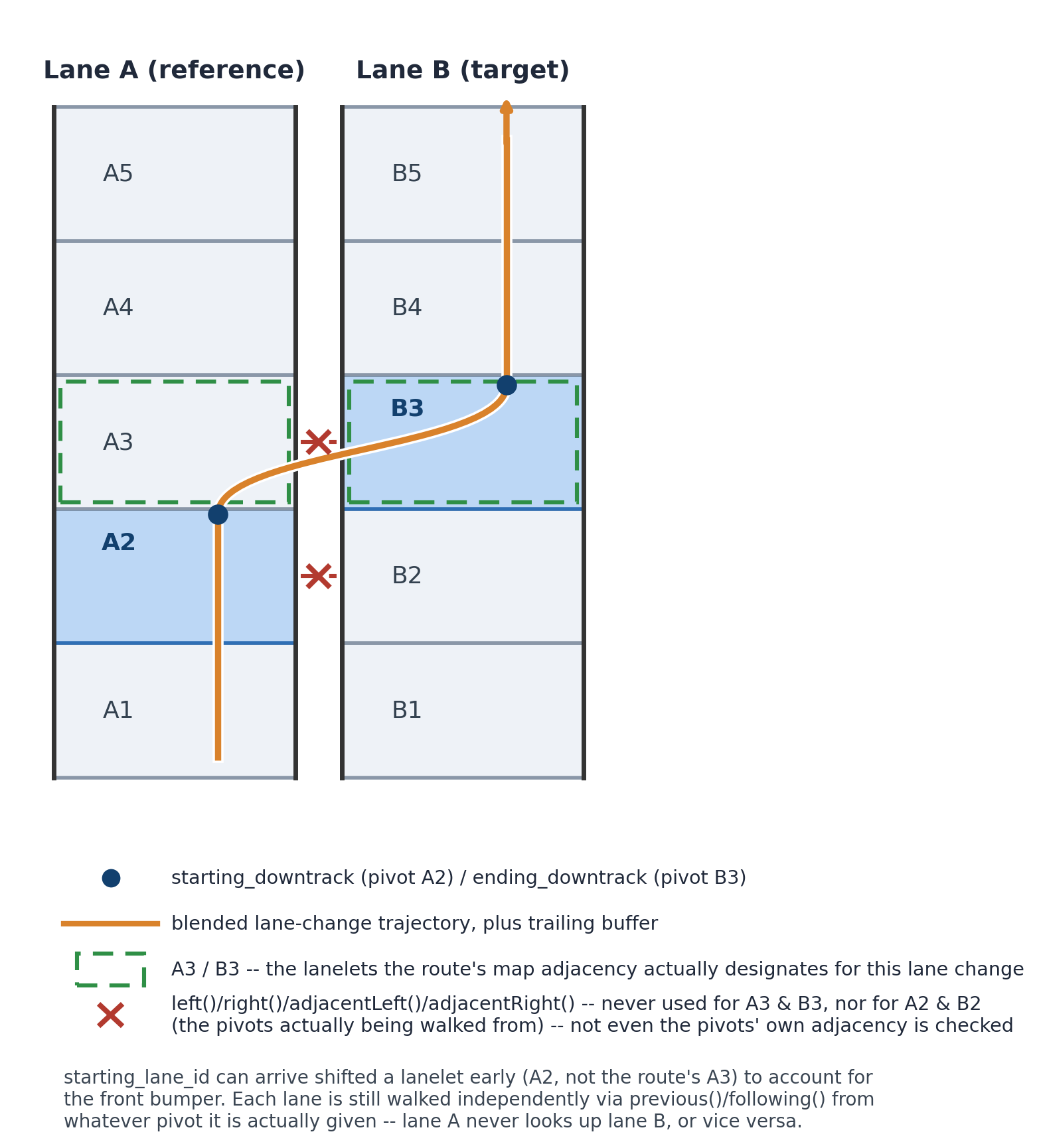
The straight segment through A1 into A2 is the vehicle simply lane-following before the maneuver
begins; the arrowhead marks the overall direction of travel (downtrack increases going up the
diagram). A3/B3 are the lanelets the route’s map adjacency actually designates for this lane
change (they genuinely share a boundary). But starting_lanelet as received by this function is
frequently not the route’s intended lanelet – plan_delegator shifts it back a lanelet (here, to
A2) to account for the vehicle’s front bumper reaching the lane-change point before the vehicle’s
reference point does. Each lane is still walked as its own self-contained chain, outward from
whatever pivot it is actually given (A2 for the reference lane, B3 for the target lane), backward
for backward_length and forward for forward_length. Neither lateral link is ever queried – not
A3/B3 (the pair the route intends), and not A2/B2 (the pair actually being walked from
either) – both shown crossed out above.
Limitation: a closure on either side can pull the trajectory over it
Because of that straight-line fallback, either lane’s own chain can independently run out before covering the required length – a closure isn’t only a problem for the target lane; the reference lane’s own forward walk needs to reach just as far, and can just as easily be blocked. CLC still successfully generates a trajectory rather than failing, but the result can end up passing directly over the closed lanelet’s own real footprint.
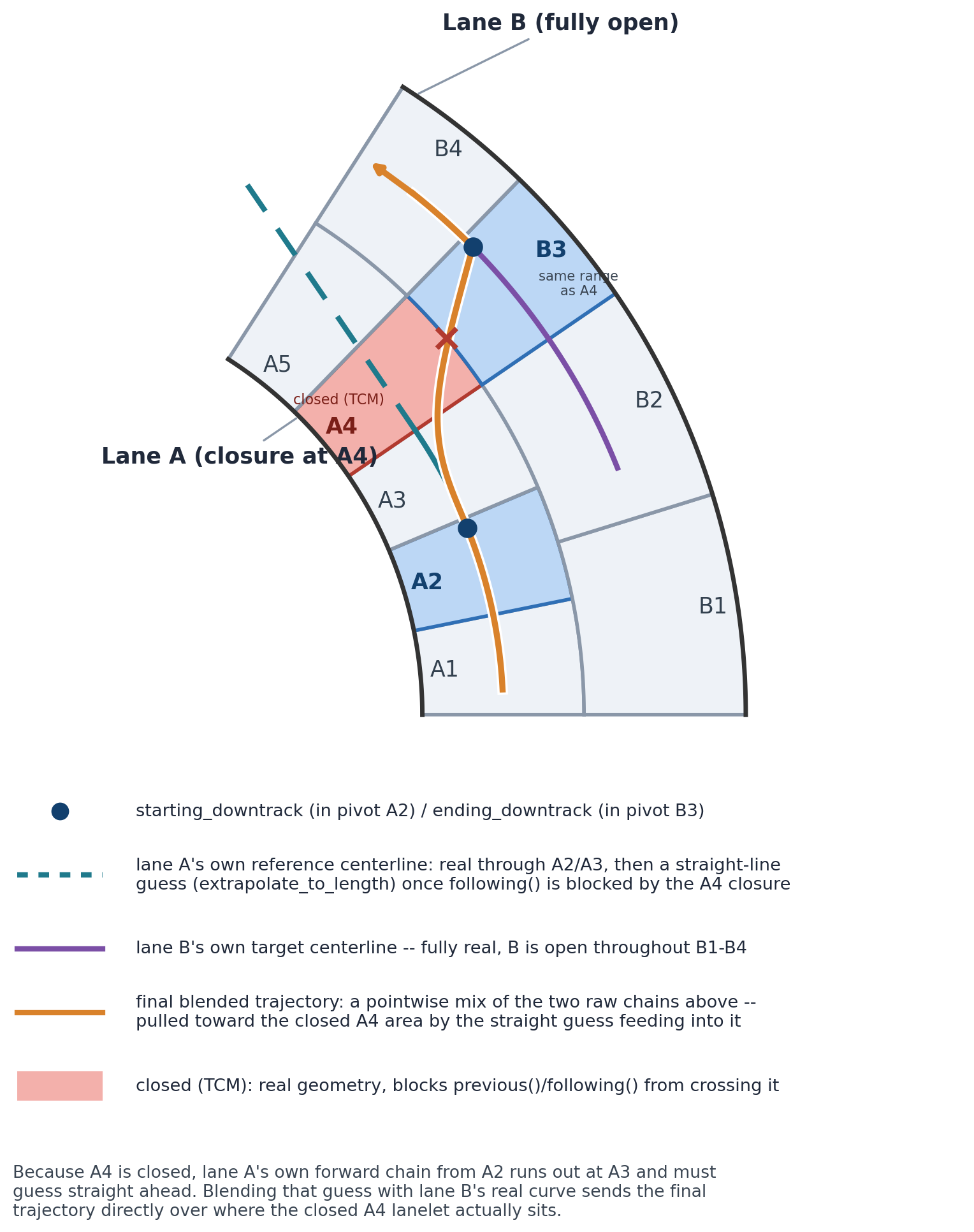
As before, the straight orange segment through A1/A2 is the vehicle lane-following before the
maneuver starts, and the arrowhead marks the direction of travel. Here A4 is closed – B is the
lane that’s fully open throughout, and the trouble is on the reference side instead.
starting_lanelet (A2)’s own forward chain is real through A3, but following() fails at the
A4 closure, so extrapolate_to_length continues it as a straight line (teal, dashed) in the last
known heading. ending_lanelet’s own chain (purple) needs no such help – B is open the whole way,
so it stays real from B1 through B4. The actual trajectory create_lanechange_geometry emits
(orange) is a pointwise blend of those two raw chains, the same way it always is, so it always stays
between them – but because one input is a straight guess sitting almost exactly where the real,
closed A4 lanelet is, the blend dips directly into that closed lanelet’s own footprint for a real
stretch before climbing back out to meet lane B’s real curve. B3 is sized to the exact same
downtrack range as A4 (and ends up larger purely because it’s the outer, larger-radius lane on this
curve) – their adjacency genuinely exists here too, and is, once again, never queried. CLC has no
idea A4 is closed or that its own blend happens to cross it.
TLDR: keep the lane change’s two segments (reference lane and target lane, over the lane change
length) the same accessible length in the map, on both sides. start_lanelet and end_lanelet
themselves can differ in length and need not be perfectly adjacent – but walking forward/backward
along their respective lanes to cover the lane change must remain accessible on both sides, and pull
in as much of the routing graph as possible.
Package Dependencies
| Deps | Name |
|---|---|
| carma_cmake_common | |
| ament_cmake | |
| ament_cmake_auto | |
| ament_lint_auto | |
| ament_cmake_gtest | |
| rclcpp | |
| carma_ros2_utils | |
| rclcpp_components | |
| carma_planning_msgs | |
| carma_debug_ros2_msgs | |
| lanelet2_core | |
| trajectory_utils_ros2 | |
| carma_wm | |
| autoware_msgs | |
| tf2 | |
| autoware_auto_msgs |
System Dependencies
Dependant Packages
Launch files
Messages
Services
Plugins
Recent questions tagged basic_autonomy at Robotics Stack Exchange
Package Summary
| Version | 5.0.0 |
| License | Apache 2.0 |
| Build type | AMENT_CMAKE |
| Use | RECOMMENDED |
Repository Summary
| Description | |
| Checkout URI | https://github.com/usdot-fhwa-stol/carma-platform.git |
| VCS Type | git |
| VCS Version | develop |
| Last Updated | 2026-10-06 |
| Dev Status | UNKNOWN |
| Released | UNRELEASED |
| Contributing |
Help Wanted (-)
Good First Issues (-) Pull Requests to Review (-) |
Package Description
Maintainers
- carma
Authors
basic_autonomy
The basic_autonomy library includes functions for waypoint processing, which are used by tactical plugins in order to generate detailed trajectories for the CARMA system.
Lane Change Geometry (CLC)
create_lanechange_geometry (src/basic_autonomy.cpp) builds the trajectory geometry for a lane
change maneuver, such as the one used by the cooperative_lanechange plugin. It blends a
centerline from the starting/reference lane into a centerline from the ending/target lane over the
length of the lane change, plus a trailing buffer.
Core logic: walk each lane’s own chain, not “what’s adjacent”
The two centerlines are built independently by build_chain_centerline (src/helper_functions.cpp),
one call per lane, each starting from a single pivot lanelet (starting_lanelet for the reference
lane, ending_lanelet for the target lane) and walking outward along that lanelet’s own
previous()/following() chain in the routing graph until enough length is covered.
This deliberately avoids ever asking “what lanelet is adjacent/left/right of lanelet X” for the
lanelets along the way. Lateral adjacency (left()/right()/adjacentLeft()/adjacentRight())
requires the two lanes’ boundaries to be explicitly linked in the map (literally the same boundary
linestring), which can be missing or stripped – e.g. a TrafficControlMessage closing a lanelet,
or lanelets that were simply never linked in the source map. previous()/following() only require
that a lanelet be routable, a much weaker and more commonly-satisfied requirement. Because of this,
starting_lanelet and ending_lanelet do not need to be adjacent to each other or the same length
– they just each need to sit on an accessible (routable) chain within their own lane, walked as
far forward/backward as needed to cover the lane change length plus buffer. In other words: pull in
as much of the routing graph as is actually reachable, independently per lane, rather than relying on
cross-lane linkage that may not exist.
If a lane’s chain runs out before covering the required length (e.g. a closed or unmapped lanelet
blocks further routing), extrapolate_to_length pads the centerline with a straight-line
extrapolation instead of throwing, so trajectory generation always produces a usable result.
The straight segment through A1 into A2 is the vehicle simply lane-following before the maneuver
begins; the arrowhead marks the overall direction of travel (downtrack increases going up the
diagram). A3/B3 are the lanelets the route’s map adjacency actually designates for this lane
change (they genuinely share a boundary). But starting_lanelet as received by this function is
frequently not the route’s intended lanelet – plan_delegator shifts it back a lanelet (here, to
A2) to account for the vehicle’s front bumper reaching the lane-change point before the vehicle’s
reference point does. Each lane is still walked as its own self-contained chain, outward from
whatever pivot it is actually given (A2 for the reference lane, B3 for the target lane), backward
for backward_length and forward for forward_length. Neither lateral link is ever queried – not
A3/B3 (the pair the route intends), and not A2/B2 (the pair actually being walked from
either) – both shown crossed out above.
Limitation: a closure on either side can pull the trajectory over it
Because of that straight-line fallback, either lane’s own chain can independently run out before covering the required length – a closure isn’t only a problem for the target lane; the reference lane’s own forward walk needs to reach just as far, and can just as easily be blocked. CLC still successfully generates a trajectory rather than failing, but the result can end up passing directly over the closed lanelet’s own real footprint.
As before, the straight orange segment through A1/A2 is the vehicle lane-following before the
maneuver starts, and the arrowhead marks the direction of travel. Here A4 is closed – B is the
lane that’s fully open throughout, and the trouble is on the reference side instead.
starting_lanelet (A2)’s own forward chain is real through A3, but following() fails at the
A4 closure, so extrapolate_to_length continues it as a straight line (teal, dashed) in the last
known heading. ending_lanelet’s own chain (purple) needs no such help – B is open the whole way,
so it stays real from B1 through B4. The actual trajectory create_lanechange_geometry emits
(orange) is a pointwise blend of those two raw chains, the same way it always is, so it always stays
between them – but because one input is a straight guess sitting almost exactly where the real,
closed A4 lanelet is, the blend dips directly into that closed lanelet’s own footprint for a real
stretch before climbing back out to meet lane B’s real curve. B3 is sized to the exact same
downtrack range as A4 (and ends up larger purely because it’s the outer, larger-radius lane on this
curve) – their adjacency genuinely exists here too, and is, once again, never queried. CLC has no
idea A4 is closed or that its own blend happens to cross it.
TLDR: keep the lane change’s two segments (reference lane and target lane, over the lane change
length) the same accessible length in the map, on both sides. start_lanelet and end_lanelet
themselves can differ in length and need not be perfectly adjacent – but walking forward/backward
along their respective lanes to cover the lane change must remain accessible on both sides, and pull
in as much of the routing graph as possible.
Package Dependencies
| Deps | Name |
|---|---|
| carma_cmake_common | |
| ament_cmake | |
| ament_cmake_auto | |
| ament_lint_auto | |
| ament_cmake_gtest | |
| rclcpp | |
| carma_ros2_utils | |
| rclcpp_components | |
| carma_planning_msgs | |
| carma_debug_ros2_msgs | |
| lanelet2_core | |
| trajectory_utils_ros2 | |
| carma_wm | |
| autoware_msgs | |
| tf2 | |
| autoware_auto_msgs |